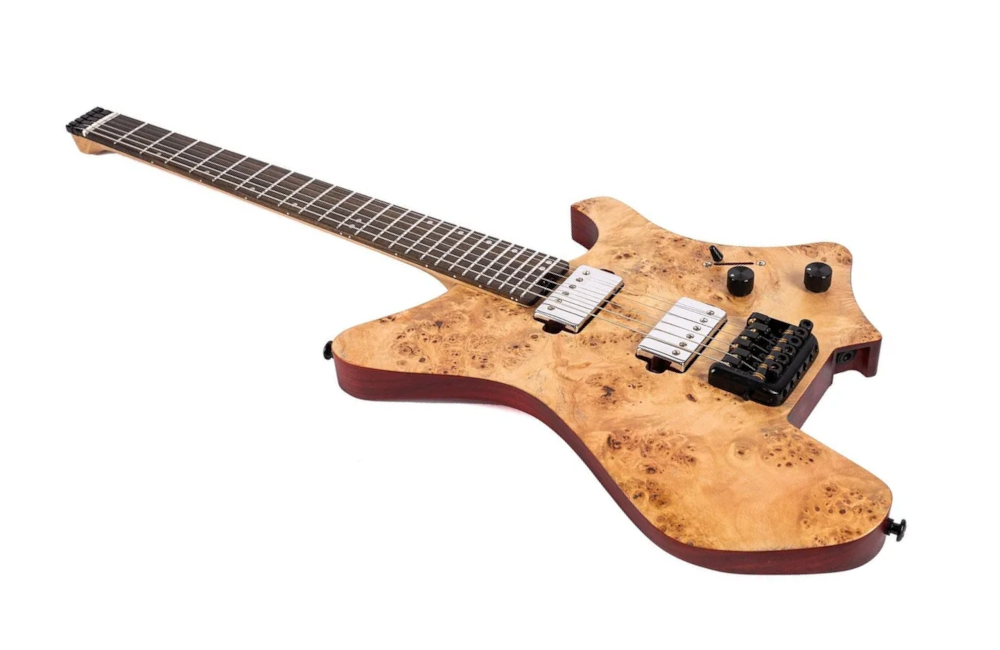
this guitar not only shifts the dial for appearance, but also for the cost of a quality guitar. is anything missing – apart from the headstock?
where we are is where we’ve always been
I love electric guitars. the expression in terms of tone is truly incredible, even before you think about adding a pedal, which opens up a limitless world of weirdness and individualism.
but looking at the mainstream market, you could be forgiven for thinking the development clock stopped somewhere around 1960. sure, there are outliers that tried new body shapes aimed to appeal to different player tastes, but by and large, Gibson’s Les Paul, Fender’s Stratocaster and Telecaster are where the smart money goes for collectors and where to find ‘the tone”.
wiping the drawing board clean
analysing the overall design, an electric guitar most usually comprises of a solid block of wood for the body, a neck comprising of a flattened baseball bat-like piece of wood with a thin layer of rosewood or similar for the fretboard and of course the elephant in this particular room, the headstock, or lack thereof, which usually serves as both a place to tune the strings but also a billboard for the guitar’s branding. you might say this is how it is, there’s little room for altering that other than tweaking the body shape. But the guitar being reviewed here ploughs a different furrow entirely.
many guitarists will point out that there’s been many headless guitars before, one of the first being the Steinberger back in the 80’s – a full thirty years after the launch of conventional electric guitars. These were embraced by jazz and early fusion players mainly but never really caught on. They looked very weird, had tiny unergonomic bodies and were expensive.
enter strandberg
everyone forgot about Steinberger and went back to the old guitars again. a further nearly 30 years passed before, in 2012 an innovative Swedish builder, Ola Strandberg re-introduced headless guitars to the market again. the new company bearing his name – the logo was stylised to read “.strandberg*” – offered a real alternative to the norm. a true headless design, but this time, every aspect was reconsidered and thought through with a body design that allowed players to sit and place the instrument on either leg, in both a classical stance or in the conventional modern style. it not only looked like a serious guitar, it had real features that changed totally the playing experience. the greatest of these was the EnduraNeck profile.
this neck, unlike a normal baseball bat profile of most modern guitars, uses a profiled back that places the thumb in its ideal position of behind the neck. strandberg patented this feature and employs it on every strandberg guitar that leaves his factory.
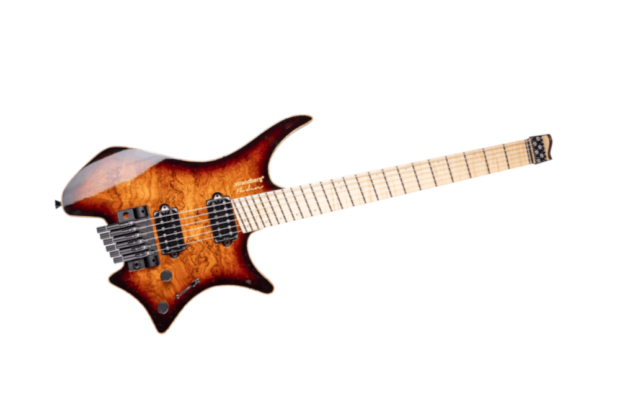
strandberg’s instruments feature a range of six, seven and eight string models with straight, fanned fret multi-scale fretboards, even one model with a wavy fret design for ultimate intonation. strandberg makes basses, too.
the strandberg range starts from around £900 for the entry models, extending to over £6000 for the specialist and artisan range.
strandberg makes great guitars. carefully designed and executed to put this premium product firmly on the map.even though they’re regarded as Swedish the instrument is actually made in Indonesia with American pickups and the only local hands-on is a set-up check before sale in Sweden.
it might sound odd for such an upmarket product to be made in the Far East. but if Ola hadn’t done this, Swedish manufacturing costs would have literally priced his guitars out of the market entirely and made development of new models prohibitorily expensive, too.
let’s talk about the Eart
now I know we’re talking here about a guitar made in the Far East and sold on Amazon as well as directly from Eart global stores in the US, Europe and China. while Eart produces a wide range of well made conventional guitars, its their headless range that has set the market on fire. before you dismiss the company as just another copy of western or Japanese products, let me just say that this Eart guitar isn’t just a good headless guitar at the price point, its an incredible guitar at a any market level – and maybe even challenge Strandberg’s own models in some areas, particularly at Strandberg’s entry level products.
let me just say that this Eart guitar isn’t just a good headless guitar at the price point, its an incredible guitar at a any market level
that name – is it pronounced “ert”, or “heart” without the “h”?
let’s clear that up right away as everyone seems to be confused about it. the name is a shortening of “electro acoustic art“, hence “Eart”. simple when you know. but let’s take a deep dive into the company, because these guys don’t just make cheap copies of the West’s mainstream guitars. they’ve pitched their offering at the premium end of the market but at a highly affordable price.
clearly, the design follows the silhouette of a Strandberg. the compact ergonomic body is crafted from exotic woods and features a very high quality neck again fusing premium woods and componentry. more of this later.
Eart has invested heavily into this brand. they’ve been around for a few years now, selling guitars globally. obviously, having a distributed logistics chain helps Eart stay under the radar of the various tariff wars and also shortens delivery times. the sheer quantity of product sold should present a logistical challenge, in terms of delivery and quality, but the amazing thing is that the sheer consistency and quality is unwavering in any market they serve.
quality isn’t just a problem for low priced guitars. even the big name US brands all have huge issues with what arrives with their customers. both Fender and Gibson score poorly with badly finished necks and playability out of the box – at every level. yet with Eart, the materials, build quality and presented finish of technical features and set up puts every company to shame. Eart’s specification chart would make even the specialised “custom shop” models blush.
those necks
the West’s mainstream high-end models will often boast about their roasted, exotic wood necks and some even feature multilayer construction. but their elegantly presented hardwood fretboards and fret material often come with mid-thousand dollar price tags. but guess what?
you get all that and more with Eart. the frets are perfectly finished and highly polished stainless steel. the fretboards are beautiful woods. they even feature a perfectly finished zero fret and genuine bone nut – no plastic here – that clearly has had a lot of time spent on it. you’ll never see a poorly finished fretboard. no one has reported one ever as far as I can see. but there’s more.
The neck profile is a compound radius design, using a 9.5 inch radius flattening out to 14 inches towards the body. the back of the neck has a U-profile at the neck moving to a C-profile at the body join to fit the hand better. while Eart can’t pretend to offer the strandberg’s exotic thumb tracking back, you get a neck that feels like the best of any guitar at any price. its unbelievable.
The model I’m reviewing here is their GW-2 model. This is their mid-tier range that features an exotic wood neck which has five layers – roasted American maple with two stripes of exotic Padouk wood. it looks premium.
easy barrel nut truss-rod
the neck was supplied with a fairly high action which is common with any guitar shipped any distance across differing weathers and humidities. this can be easily adjusted to a player’s preference (more of this later). many guitar necks are shipped with a degree of “relief”from the factory, a slight bow-like curve mid curve for the same reason.
Eart have even made neck relief adjustment a simple job. you get a small tool kit with a screwdriver-like tool to access the body-end truss-rod to set the neck relief to your preferred angle. some players like a small degree of relief, others go for the low action afforded by a flatter angle. its a two minute job even with strings on and tensioned. again, everything has been considered.
finally, the neck is secured with four recessed screws and nicely profiled into the contoured neck pocket.
the body
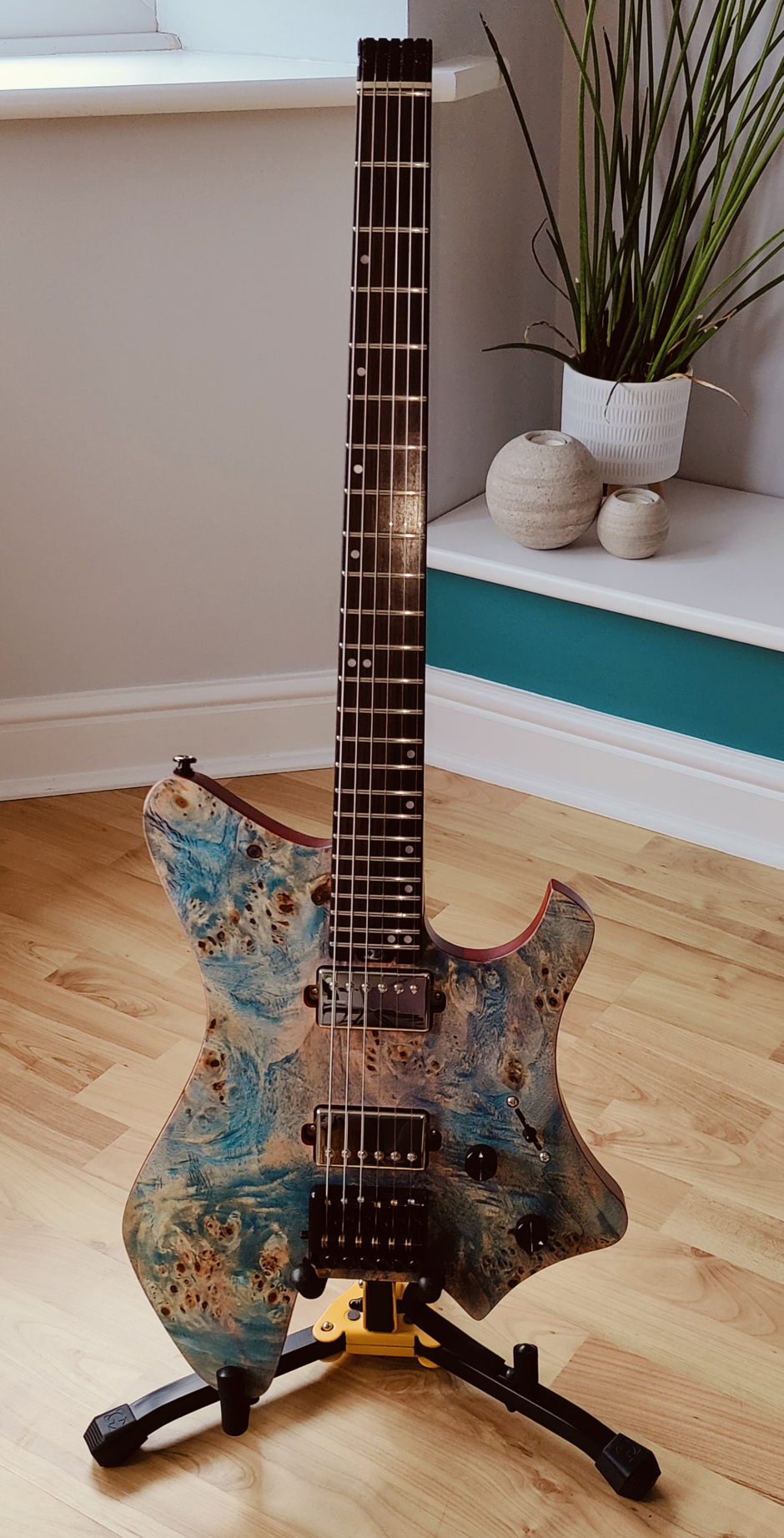
I mentioned the strandberg-like profiled body. this GW-2 version is comfortably contoured from Padouk wood in a rich reddy-brown. this wood is renowned to change colour under UV light so will age well. the top is heavily profiled. this model has a thin blue burl top with open pores. very classy.
looking at the back of the body, you find a beautifully machined and finished wiring compartment with a ground wire screwed to it internally. I didn’t measure the resistance to see if this was conductive paint or not, but should extra screening be needed for use in a noisy electrical area, its a simple task given the smooth quality of the inner wood and fitted ground tag.
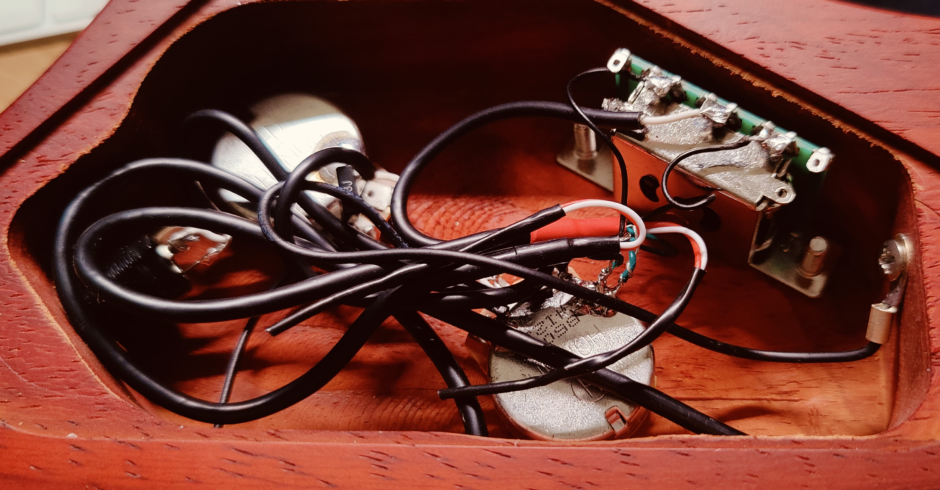
before I leave the inner access cover, I have to mention the output jack pocket. most guitars feature an outer body-shaped jack socket which often seems an afterthought. they can be rectangular (Gibson-style), football shaped (Ibanez). only Fender’s Stratocaster recesses its jack socket on the top of the body offer some integration. the Eart follows the strandberg here by recessing the rear edge of the body specifically for the jack lead, fitting a barrel connector to avoid interference by the lead when sitting down to play. a nice touch. onto the hardware…
make or break – the choice of hardware
its very common for manufacturers to get to a specific price point by fitting poor quality hardware. this spoils the feel of the instrument and although it can be easily upgraded to higher quality components, this can cost a lot more than expected and can almost approach the cost of the instrument again if every piece of hardware has to be replaced.
this is something that surprised me about strandberg. strandberg have two levels of instruments – entry level and professional. yet they’ve fitted the same bridge is fitted to all their instruments. while there is nothing wrong with the quality of strandberg’s hardware, when you buy their top of the range instrument, nearly four times the entry level, you still only get the entry level hardware. that’s a tough sell!
Eart’s hardware is beautiful. the bridge is a feat of engineering in itself. on the GW-2 here, its fixed and has rollers and an almost clockwork quality string tensioner rollers activated by hex keys, for which Eart has supplied a neat magnetic key and crank to tension or undo the strings. this is a very cool feature. the only downside is if you lose the key on a dark stage or dressing room, they don’t list a replacement. however, the tensioners are relatively easy to turn by hand, by a standard hex key or even with a coin should the worst happen. the image shows the adjuster crank in the high E saddle.
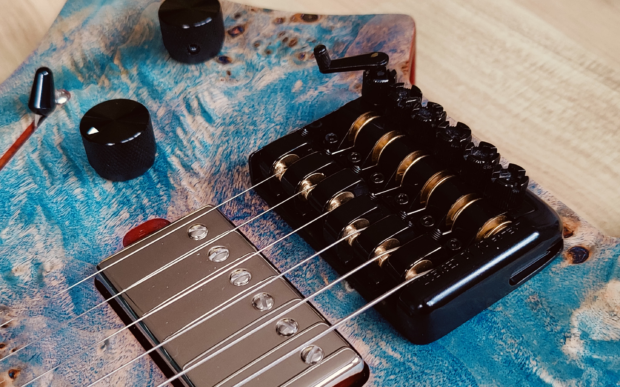
To adjust the action height Eart has provided rotating rollers in each string saddle.
these have two screws, one unlocks the roller and another allows the roller to rotate higher or lower. once set, just tighten the locking screw and you’re done.
for intonation adjustment, the saddles have a further allen screw behind each saddle. loosening this allows the saddle to be pushed forward or back according the note tone.
the string end stop
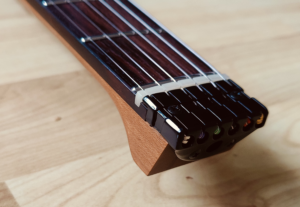
moving along to the opposite end of the strings, you come across the string stop. this sits at the nut and the string are fed through to the bridge.
standard string barrels stop the strips here, so no special headless strings are needed nor any allen keys necessary to lock the strings. one up on the fiddly strandberg string changing routine, which requires the strings to be screwed down.
once again, this little component is polished and perfectly fitted to the “heel” of the neck and looks very professional and should last for the life of the guitar. now, on to the pickups and controls…
its all about the sound
This is where Eart could have been forgiven had they fitted cheap pickups, wiring and controls. but surprisingly, unless you wanted something unique to a your taste, nothing needs to change. the guitar is equipped with a pair of Eart’s own Custom Classic 57 Alnico-V Set (ECC57S) humbuckers. they’re richly voiced to provide a characterful tone and even strandberg players would recognise the “headless tone” that you seem to get with this type of guitar.
The pickup wiring is good quality, generously long – maybe a bit too long if truth be told, but the soldering is slick and tidy. the extra wires needed for coil tapping are neatly insulated in shrink wrap for a future upgrade if desired.
the final hardware complement is completed with a couple of nicely damped full size 500K pots. one for volume and the other for tone. these are topped with high quality (and well aligned) black metal knobs with allen key fixings. the pots are have the right electrical tapers (log and lin) for each pot, so settings are nicely scaled and the tone rolls off evenly. a good quality 220pf capacitor handles tone duties. switching is provided by a covered three way selector for neck alone, middle both, bridge alone choices. pickup volumes are full, expressive, well matched and tonally distinct.
yes, but… ?
so far, a pretty glowing review. but what would I like to see that’s not here, or what is that I would prefer not to have?
well, one item falls into both categories, I guess. And that’s the bridge. nothing wrong with it per se. I mean, it works fine, perfectly, in fact. that’s not the issue. its the fact that its not a tremolo bridge. and I miss that, hugely.
its not offered as an option at all. I can’t see one that might fit or not without major body surgery, at least. and that above all things has given me the lost cause to worry. its because all my serious guitars I have had and loved to play have had trems on them. my style of playing revolves around the whammy bar. the frustrating thing is, you can feel the tone just bursting to get out. to be honest, it would be absolutely perfect with a tremolo. but for that, you have to go to the professional model, the GW-2 Pro. and that costs a lot more, virtually double the price. I think that’s a mistake.
of course, other people’s mileage may differ. they might get on just perfectly without a trem and the original GW-2 bridge already fitted is perfect – for a fixed bridge.
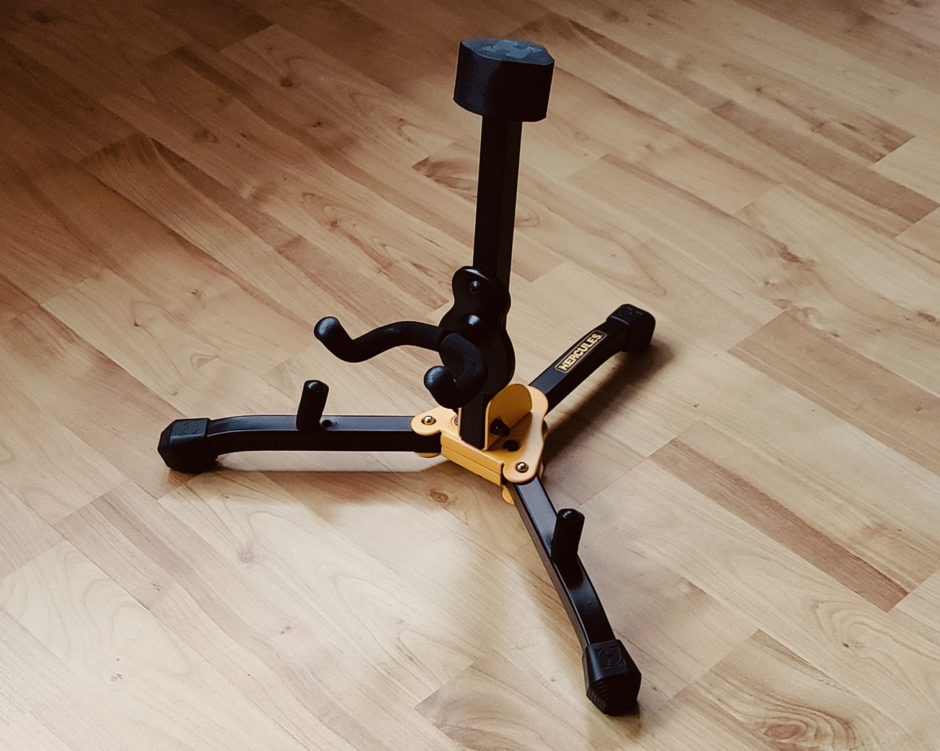
The final issue’s not so much a problem with the guitar at all, but with its shape and how to transport it. there’s no hard case offering. there’s a gigbag offered but not supplied and it costs an extra £200. That’s a lot of money for a gigbag – a lot more than a decent case.
additionally, there are no stands for headless guitars. Most either hang from (you’ve guessed it) the headstock and of course without the stand won’t work. Of course, Hercules make great stands that support a guitar from the body, but they rely on a rounded body for support. the Eart body shape precludes this. but with a little ingenuity, I found a way.
I took my existing Hercules stand and bought a wall hanger from Amazon. I screwed the wall hanger to the back support and was able to fit the hooks intended for the headstock under the ledge beneath the bridge. that works just fine.
but I shouldn’t have to do that. anyone gigging this guitar or even travelling with it will have to find a way of adapting or having a custom flightcase made. not a big deal, but again, you shouldn’t have to. here’s an image of my solution for the stand. its pretty elegant to be fair!
conclusion
that’s it. a fabulous guitar, a worthy low cost alternative to a strandberg. great quality with no compromises at all.
just give me a tremolo, a stand and a case and this will be the most perfect guitar I have ever seen.
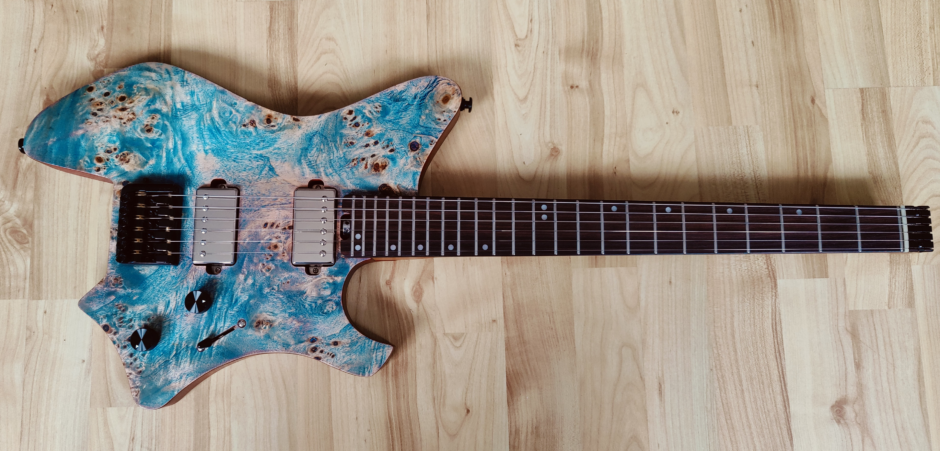
the Eart GW-2 as reviewed here. its a pretty guitar you could hang on the wall as a piece of art.
so there you are. a guitar well worth losing your head for.